Choosing granite color and finish for a headstone
Color and finish do more than set a mood: together they decide how clearly the lettering reads from the path.
October 2, 2026 · 4 min read
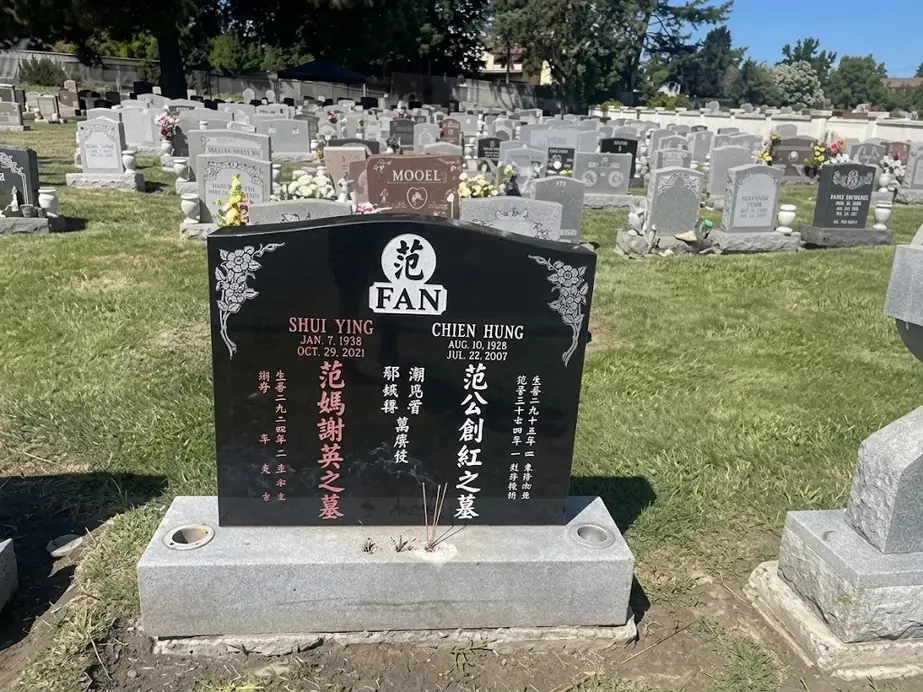
Standing in front of sample stones, many families discover that choosing a memorial is less about the shape than about the feel of the material. A deep black polished face is quiet and formal. A soft grey is gentler and often warmer in daylight. Neither is correct. Each simply changes the way a name looks once it is cut into the stone.
This article covers the granite tones we work with, the finishes that go on them, and the one idea that ties both together: how well the lettering will read, in morning light and late afternoon, from a few steps away.
Why granite is the usual choice
Granite is dense, hard and slow to weather, which is why it has been the standard material for cemetery memorials for so long. It takes a high polish, holds deep-cut letters crisply, and doesn't soften at the edges the way some stones do. Gray Stone Monument works in high-grade, weather-resistant granite, and in marble for certain uprights and custom work.
Granite is an igneous rock formed under heat and pressure, which means each piece has its own pattern of crystals. Two stones of the same named type can differ in grain and in small flecks of lighter or darker mineral. That's part of its character, and a good reason to look at an actual sample rather than relying on a printed color chip.
The tones: grey, black, blue and traditional
We offer granite in blue, grey and black, along with traditional tones. Each carries a different mood and a different relationship to the lettering.
- Grey is the most familiar tone. It ranges from pale silver to a deeper charcoal, suits almost any setting, and shows both polished and frosted surfaces well.
- Black gives the strongest contrast with lettering, particularly when the characters are frosted or etched lighter than the polished face.
- Blue tones sit between the two, cooler than most greys, and often have a gentle depth that changes with the light.
- Traditional tones are the classic memorial colors many families remember from older sections of a cemetery, and they sit comfortably beside existing stones.
If the stone is joining a family plot, it's worth looking at the neighboring memorials first. Some families match them closely, and others choose a complementary tone on purpose.
The finishes: polished, pitched rock and frosted
A polished finish is smooth and reflective. It brings out the full depth of the stone's color, and it makes deep-cut letters stand out cleanly. It also reflects its surroundings, which can be lovely, and it will show dust and water spots until it is cleaned.
A pitched rock finish is the opposite: a rough, natural-looking face, often used at the edges of a stone or on a border. The contrast between a pitched edge and a polished panel gives a memorial texture and weight, and it feels closer to raw stone.
A frosted finish is a fine, matte surface. Frosting is commonly used for lettering and for etched designs, because the pale matte characters set against a polished dark face are very easy to read. Frosted panels can also be used as a design element in their own right.
Many memorials combine these, mixing smooth polish, pitched rock and frosted areas on a single stone to suit the design.
How finish affects the way lettering reads
Legibility is the practical test of any choice. Lettering is seen at an angle, in changing light, and often at a distance of several steps. The strongest readability usually comes from contrast: pale, frosted characters on a dark polished face, or deep-cut letters on a lighter polished grey where shadow in the cut does the work.
Glare is the other factor. A mirror-polished face can bounce direct sun back at the visitor and make the surface hard to read for part of the day. A stone that is partly frosted or textured diffuses the light and keeps the inscription clear. The direction a stone faces matters here, which is one more reason to talk about the actual plot.
Letting the stone and the family lead
Practical questions are useful, but the most reliable guide is often a personal one. Which stone do you picture without trying? Some families choose a color because it echoes a favorite garden, a car, a uniform, a coastline. There's no need to justify a preference to anyone.
Whatever you choose, remember that the cemetery may have its own requirements for material or finish in your section, so ask the cemetery office or let us check. Gray Stone Monument serves Sacramento, Elk Grove and the surrounding area, and a free memorial consultation is available by phone at (916) 300-5785, Monday through Friday, 8am to 5pm.
Nobody will ask you to decide on the spot. Look, ask questions, take your time.
Gray Stone Monument, (916) 300-5785
Call (916) 300-5785More articles
Headstone or grave marker? Flat, bevel, slant and upright explained
The words get tangled quickly, so here is a calm way to tell the four common memorial shapes apart.
Why cemetery rules shape your headstone, and how to find out what applies
A cemetery's guidelines can feel like an obstacle, but they are easier to work with once the reasons behind them are clear.