Headstone or grave marker? Flat, bevel, slant and upright explained
The words get tangled quickly, so here is a calm way to tell the four common memorial shapes apart.
October 2, 2026 · 4 min read
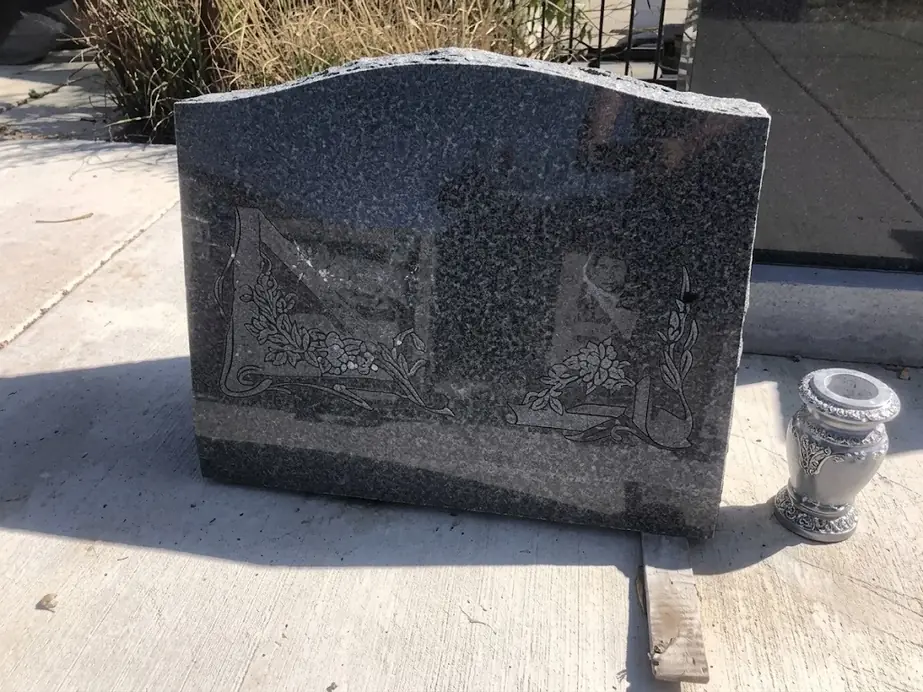
When a family begins planning a memorial, the vocabulary gets tangled almost at once. Headstone, gravestone, grave marker and monument are used as if they mean the same thing, and in everyday conversation they often do. Once decisions have to be made, though, the differences matter, because each word points toward a different shape of stone and each shape suits a different kind of space.
Here is a plain way to sort it out. We'll walk through the four styles you'll hear about most: flat, bevel, slant and upright. None is better than the others. They answer different questions about the cemetery and the family.
What the words usually mean
A grave marker most often describes a low stone that sits level with the ground or only slightly above it. Headstone is the broader word, used for nearly any stone placed at the head of a grave. Monument tends to mean something larger and more substantial, such as an upright stone made for two people, or a family stone meant to stand for several generations.
Because the terms overlap, the more useful question is how tall the stone will be, how it will sit on the ground, and how much surface there is for lettering and artwork.
Flat and flush markers
A flush marker lies flat, with its top surface level with the surrounding grass or just a little above it. Many cemeteries have lawn sections where the grounds crew needs to mow straight across the graves, and a flush marker fits that way of working. Each cemetery decides which sections allow which types of stone, so this is worth confirming early with the cemetery office.
Flat markers are compact, and that brings a few practical points to keep in mind.
- The surface is small, so the wording needs care.
- The lettering faces upward, so sun and weather reach it directly. Deep-cut letters on a polished face stay legible for a long time.
- Grass clippings and soil can gather at the edges, so an occasional brushing helps.
- A flat stone can still carry a border, an emblem or an etched design, provided the layout leaves room to breathe.
Gray Stone Monument makes flush markers designed and sized for the lawn requirements of cemeteries in the Sacramento area, so the dimensions are settled before the stone is cut rather than after.
Bevel and slant markers
A bevel marker is a step up from a flat one. The stone sits on a base, and its top surface rises at a gentle angle, higher at the back than at the front. That slight tilt lifts the lettering toward the eye of someone standing or kneeling beside it, so it reads more easily than a stone lying flat.
A slant marker goes further. Its face is cut at a steeper angle and the stone is taller overall, which lets the inscription catch more light and makes it easier to read from a standing position. Both can be made in granite in a range of tones.
There is a quiet practical reason to consider an angled face. If someone in the family has trouble kneeling or bending, a stone they can read while standing is kinder to visit.
Upright monuments
An upright monument stands vertically on a base, and its face is the full height of the stone. This is the style most people mean when they say headstone. It offers the most room for lettering, a portrait, a floral design or a religious symbol, and the top can be shaped with a gentle curve, a serpentine line, or a more personal outline cut to a custom contour.
Companion monuments are uprights made for two people, usually with a shared base and a layout that gives each person equal space. They're common when a couple has chosen to rest together, and they allow one side to be completed later, a situation we describe in another article on this site.
Uprights also need a proper foundation. A heavy stone set on poorly prepared ground can lean or settle over time, so foundation planning belongs in the design conversation from the start.
Questions that help you decide
If you aren't sure where to begin, these questions tend to clear things up.
- What does the cemetery allow in this section? Ask the cemetery office which types and sizes apply to your plot.
- Who will be visiting, and how often? Think about age, mobility and the distance they travel.
- How much do you want written or shown on the stone? A long inscription or a portrait needs more surface.
- Will a second name be added later? That affects the layout from day one.
- Which tone of granite and which finish feel right? Grey, black and blue-toned stone look quite different in the same light.
There's no hurry in any of this and no wrong order to ask the questions in. Some families start with the cemetery's rules, others with a photograph of a stone they remember from childhood. Either way works.
Starting the conversation
Each cemetery sets its own rules about what can be placed where, so ask the cemetery office, or let us check for you. Gray Stone Monument serves Sacramento, Elk Grove and the surrounding area, and a free memorial consultation is available by phone at (916) 300-5785, Monday through Friday, 8am to 5pm. You're welcome to bring a photo, a sketch, or just a few words about the person, and we'll talk it through at whatever pace feels right.
Gray Stone Monument, (916) 300-5785
Call (916) 300-5785More articles
Why cemetery rules shape your headstone, and how to find out what applies
A cemetery's guidelines can feel like an obstacle, but they are easier to work with once the reasons behind them are clear.
Adding a final date to a headstone already in place
When a stone was made for two, completing it later is a quiet, careful piece of work that deserves to look as though it was always meant to be there.